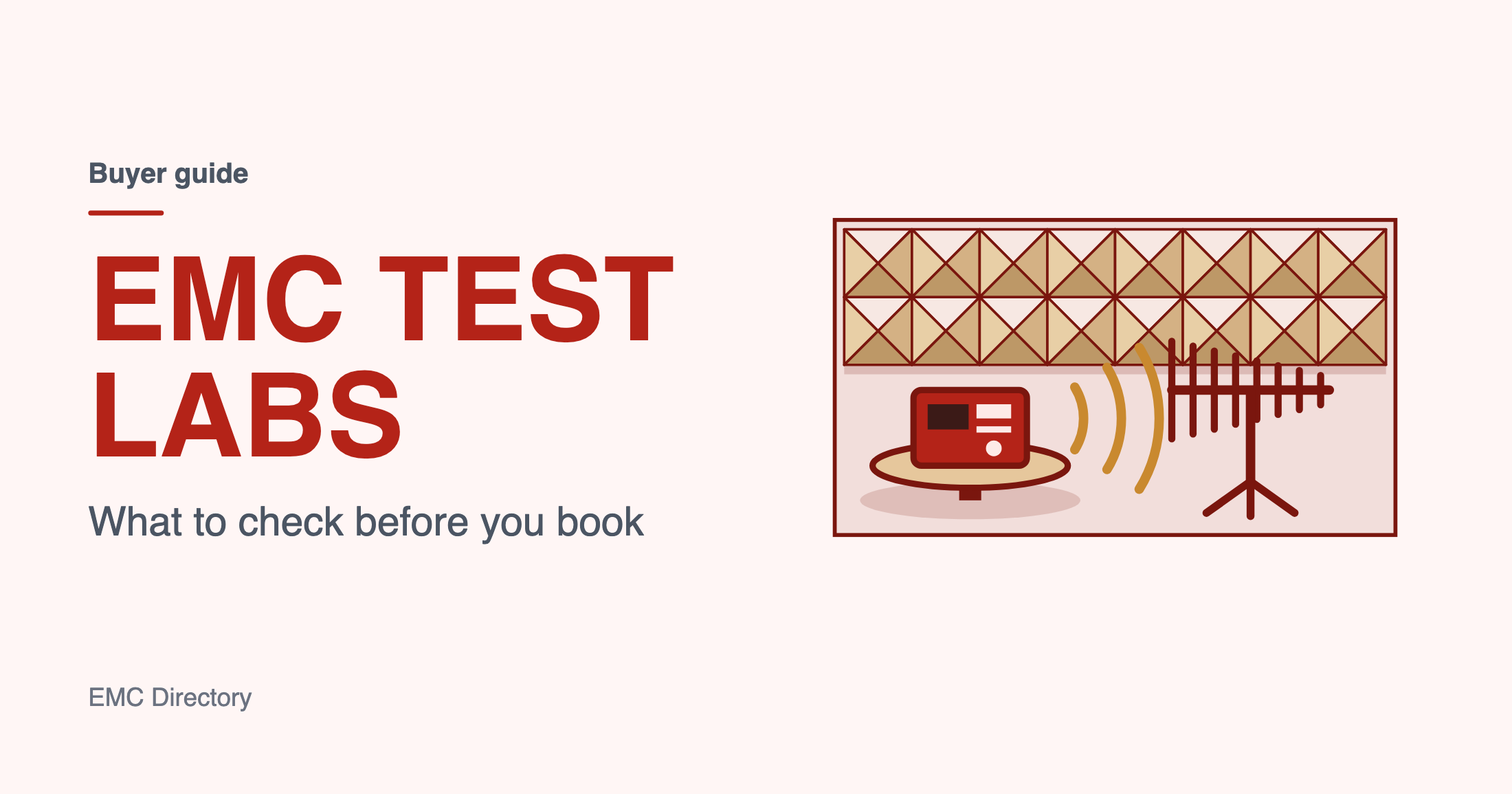
An EMC test lab is chosen the way many suppliers are: late, under schedule pressure, from a short list of names. A little time spent comparing labs against the tests your product needs avoids two costly outcomes. One is a lab that cannot run a required test and passes the job elsewhere. The other is a report that the customer or notified body refuses to accept.
1. Start from the tests you need
List the standards your product has to meet before you contact a lab. That list drives everything else. For example:
- emissions from multimedia equipment: CISPR 32 (EN 55032);
- emissions from industrial, scientific and medical equipment: CISPR 11 (EN 55011);
- immunity to radiated fields: IEC 61000-4-3;
- electrostatic discharge, fast transients and surge: IEC 61000-4-2, -4-4 and -4-5;
- conducted immunity: IEC 61000-4-6.
For products sold in Great Britain, the UK EMC Regulations 2016 apply and the UKCA mark relies on designated standards; products for other markets bring their own lists. Give a lab the exact standard, edition and limit class (Class A or Class B, for example), not just the word "EMC".
2. Read the UKAS schedule of accreditation
Many labs state that they work to ISO/IEC 17025, the standard for the competence of testing and calibration laboratories. Accreditation is more specific than that: a lab is accredited for the tests listed on its schedule of accreditation, which the UK Accreditation Service (UKAS) publishes. Check three things:
- The test is on the schedule. A lab can be accredited and still not hold accreditation for the standard you need.
- The scope matches your product. Some schedules list product families or frequency ranges. Check that your product type and your frequency range are covered.
- The accreditation is current. Compare the lab's quoted accreditation number with the UKAS register, not with the lab's brochure.
If you only need a pre-compliance or debug test, accreditation may not matter. If the report goes to a customer, a regulator or a notified body, it usually does.
3. Ask about the chamber and the test distance
Radiated emissions are measured at a defined distance, commonly 3 m or 10 m, in a semi-anechoic chamber or on an open area test site. Ask:
- Which distance does the lab use, and is it the one the standard and limit you are claiming against specify?
- Is the chamber large enough for your equipment under test, including its cabling and any support equipment? Large or tall products, rack systems and vehicles need space that a small chamber does not provide.
- Can the turntable carry the weight of your product, and can the lab simulate the real installation, such as a floor-standing unit or a wall-mounted one?
- For immunity, does the lab have the field generation capability for your frequency range and field strength?
Distance and size are not paperwork details. If your product cannot be tested as installed, or at the distance your limit assumes, the result may not be accepted.
4. Ask about equipment, software and uncertainty
You are entitled to ask what the lab measures with, and how well it knows its own results:
- Is the receiver or analyser, and the antennae, calibrated, and when is the next calibration due?
- Which software controls the test, and does the lab validate it?
- Does the report state measurement uncertainty, and does the lab apply it when deciding pass or fail? Standards and guidance differ on how uncertainty is applied, so ask the lab to state its policy.
A lab that answers these plainly and quickly is usually one that has thought about them.
5. Agree what happens when the product fails
A failure is likely at some point, so agree the process before the first booking:
- Does the lab offer diagnostic work on site, such as near-field probing or a quick re-run after a fix?
- How is a re-test quoted: the whole programme again, or only the failed tests?
- Can you keep the chamber booked for a fix-and-retest day, and what does that cost?
- Does the lab give you the raw data and emission scans in a form your engineers can work with, not only a pass or fail table?
6. Ask about turnaround and booking
Quote the lead time in two parts: how long until a slot is available, and how long from the end of testing to a signed report. Both can vary by season and by the lab's workload. Ask whether the lab will hold a slot while you finalise the product, and what it charges if you move it.
7. Check what the report will contain
A report that satisfies a customer or regulator usually identifies the test standard and edition, the equipment under test and its configuration, the test set-up with photographs, the limits applied, the results, the measurement uncertainty where relevant, and a clear statement of any deviation from the standard. Ask for a sample report. If the lab cannot show one, that is a useful finding in itself.
8. A quick checklist
- Do I know the standards, editions and limit classes I need?
- Is every test on the lab's UKAS schedule, and is it current?
- Does the chamber size and test distance suit my product?
- Are the equipment, software and uncertainty policy explained plainly?
- Is the re-test process, with its cost, agreed in advance?
- Are lead time to a slot and lead time to a report both stated?
- Have I seen a sample report?
Where to look
UKAS publishes the schedule of accreditation for every accredited lab. To compare UK EMC test labs and their stated services, see full compliance testing and pre-compliance testing on EMC Directory. Details in any directory are what each company states, so check them with the lab itself, and against the UKAS register, before booking.
EMC Directory (emcdirectory.co.uk) lists UK EMC test labs and consultancies. Its sister site, EMS Directory (emsdirectory.co.uk), lists UK electronics manufacturing companies.
For press enquiries, or a custom data cut from EMC Directory's dataset of UK EMC test labs and consultancies, contact emc@emcdirectory.co.uk.